

CSI Driver Overview
FlexFS ships a Container Storage Interface (CSI) driver that lets Kubernetes pods mount flexFS volumes as first-class persistent storage. The driver name is csi.flexfs.io.
Architecture
Section titled “Architecture”The CSI driver is deployed as two components:
| Component | Kubernetes resource | Purpose |
|---|---|---|
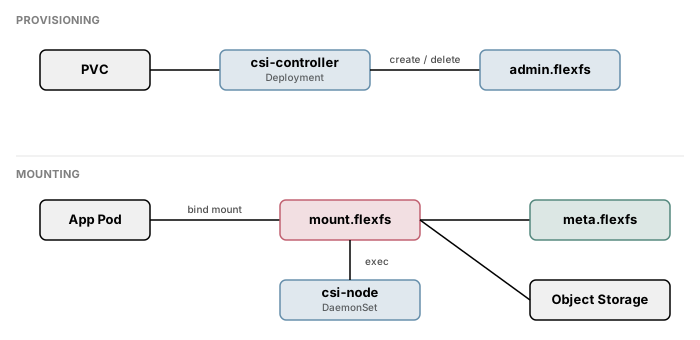
| Controller | Deployment (default: 2 replicas) | Handles dynamic volume provisioning (CreateVolume / DeleteVolume). Runs the CSI driver alongside the csi-provisioner and csi-resizer sidecars. |
| Node | DaemonSet (one pod per node) | Handles mounting and unmounting volumes on individual nodes (NodePublishVolume / NodeUnpublishVolume). Runs the CSI driver alongside the csi-node-driver-registrar sidecar. |
Both the controller and node pods run the same csi.flexfs binary. The binary implements all three CSI service interfaces — Identity, Controller, and Node — in a single process.
How it works
Section titled “How it works”- Identity service — responds to health probes and reports the driver name (
csi.flexfs.io) and version. - Controller service — advertises
CREATE_DELETE_VOLUME,EXPAND_VOLUME, andSINGLE_NODE_MULTI_WRITER. For dynamic provisioning it calls the admin server REST API to create, expand, or delete volumes. The sidecars that drive it (csi-provisioner,csi-resizer) run alongside it in the controller Deployment. - Node service — the core mounting logic. It advertises
SINGLE_NODE_MULTI_WRITER, which lets Kubernetes distinguishReadWriteOncefromReadWriteOncePod(see Access modes). When a pod needs a volume:- The driver creates a base FUSE mount by executing
/sbin/mount.flexfsinside the node pod. - It then creates a bind mount from the base mount into the pod’s target path.
- Credentials are written to a temporary file at
<kubeletDir>/flexfs/<volume-name>/creds, where<kubeletDir>is the kubelet root the driver was started with (/var/lib/kubeletunless overridden — see MicroK8s and custom kubelet directories). - There is no fixed per-node volume limit: nothing is attached to the node, so the practical ceiling is memory and file descriptors rather than a slot count.
- The driver creates a base FUSE mount by executing
When a pod is removed, the driver unmounts the bind mount. If no other pods reference the volume on that node, the base FUSE mount is also unmounted and the credential files are cleaned up.
Container image
Section titled “Container image”The CSI driver image bundles the CSI gRPC driver and the FUSE mount client.
Both amd64 and arm64 architectures are supported via a multi-arch build.
CSI driver registration
Section titled “CSI driver registration”The CSI driver is registered with Kubernetes through a CSIDriver object:
apiVersion: storage.k8s.io/v1kind: CSIDrivermetadata: name: csi.flexfs.iospec: attachRequired: false fsGroupPolicy: NoneattachRequired: false— flexFS does not require a controller-attach step; volumes are mounted directly on the node.fsGroupPolicy: None— flexFS manages its own POSIX permissions and ACLs; Kubernetes should not modify ownership.
Provisioning modes
Section titled “Provisioning modes”| Mode | Editions | Description |
|---|---|---|
| Static provisioning | Enterprise and Community | You pre-create the volume and provide a PersistentVolume that references it by name. |
| Dynamic provisioning | Enterprise only | A StorageClass triggers automatic volume creation via the admin server API when a PersistentVolumeClaim is submitted. |
Next steps
Section titled “Next steps”- Install with Helm or raw manifests
- Configuration reference for all CSI flags, Secret fields, and StorageClass parameters